There isn't an exact worldwide count of people who share your birthday in these data. We can count matching birth records in the historical U.S. sample and calculate expected matches in a clearly defined hypothetical group. Those answer different questions.
For example, September 9 accounts for 259,228 of 85,712,738 recorded U.S. births from 1994 through 2014. Its share is 0.3024%. A model that independently assigns that historical birthday distribution to 1,000 other people gives an average of 3.02 September 9 matches. It doesn't tell us how many living people have that birthday.
How many share your birthday?
Expected matches among 1,000 other people · hypothetical model
Bars: expected matches = 1,000 × historical date share, starting at zero. Independent draws with replacement. Weights: U.S. 1994–2014 birth records. Decimals are model averages, not counts of living people today.
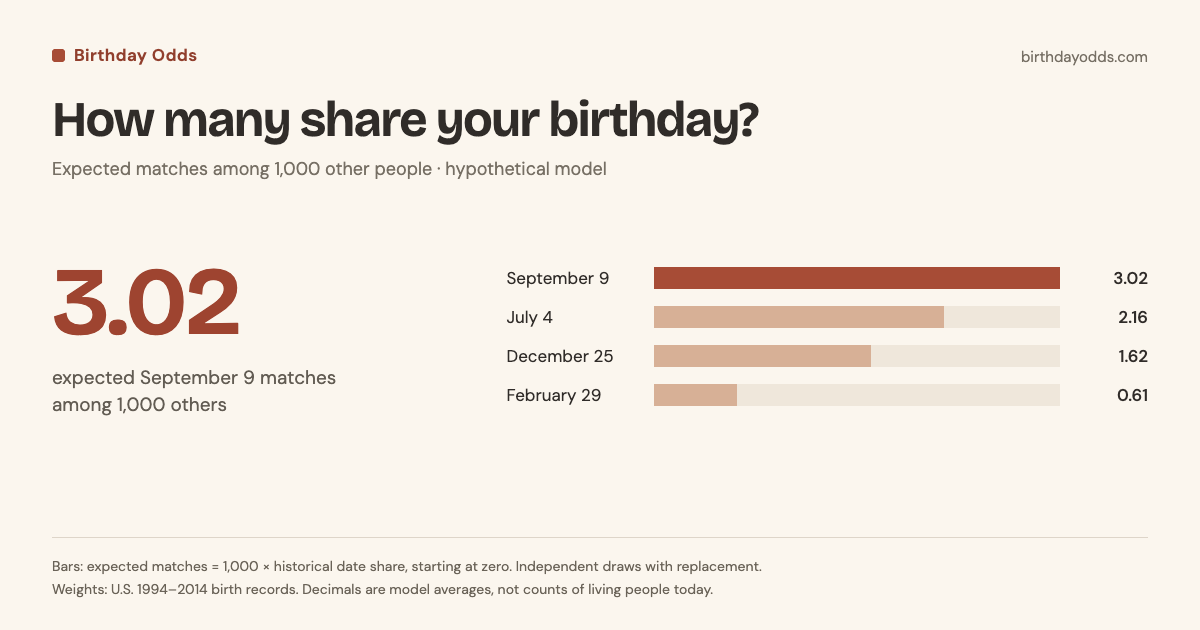
What can we actually count?
A birthday match here means the same month and day, regardless of birth year. Someone born on your exact date of birth, including the year, is a narrower match.
| Birthday | Recorded births | Share of all recorded births | Actual date occurrences |
|---|---|---|---|
| September 9 | 259,228 | 0.3024% | 21 |
| July 4 | 185,315 | 0.2162% | 21 |
| December 25 | 138,628 | 0.1617% | 21 |
| February 29 | 52,561 | 0.0613% | 5 |
These counts come from daily U.S. birth records compiled by FiveThirtyEight. They combine CDC/NCHS records for 1994 through 1999 with SSA records for 2000 through 2014, excluding overlapping years. The share divides by all recorded births in that selected period. It does not divide by the current U.S. population.
Check your own birthday to see its historical count and share. Your personal birth record may fall outside this sample, so these are not automatically counts of "other people besides you."
How many matches would a group have on average?
If your birthday has share p and you draw n other people independently from the same modeled distribution, the expected number of matches is:
Expected matches to your known birthday = n × p
The Penn State notes on the binomial distribution explain this mean. Our examples use independent draws with replacement from the historical shares. Each hypothetical person's chance is the same; the person whose birthday is known is excluded from n.
| Your birthday | Expected matches among 100 others | Among 1,000 others | Among 10,000 others |
|---|---|---|---|
| September 9 | 0.30 | 3.02 | 30.24 |
| July 4 | 0.22 | 2.16 | 21.62 |
| December 25 | 0.16 | 1.62 | 16.17 |
| February 29 | 0.06 | 0.61 | 6.13 |
A decimal expectation is an average across repeated hypothetical groups. An actual group has a whole number of matches. Among 30 other independent draws, a September 9 birthday has 0.09 expected matches, while the modeled chance of no match is 91.31%. A low expected count can therefore go along with many groups having no matches at all.
Real friends, coworkers, classmates, and relatives need not follow this model. Their ages, locations, and family relationships can make a historical U.S. distribution a poor fit. A birthday survey of your own group gives its actual count.
Why not multiply by the world's population?
Multiplying a date's historical U.S. share by a current world population estimate would give a modeled count. It would require assuming that the old U.S. distribution applies to living people across countries and generations. These files cannot check that assumption: they contain births in one country during a fixed period, with different administrative coverage across the two sources.
They also do not track who is still alive or who moved into or out of a population. We therefore do not present that multiplication as a measured global birthday count. The methodology explains the records and their limits.
February 29 needs particular care. Its total share includes fewer actual calendar occurrences; dividing every population evenly among the dates would answer a different question. See the leap-day rarity explanation for that distinction.
Is this the birthday paradox?
Counting people who match your known date is different from asking whether anyone in a group shares any birthday. The two-person probability guide explains a specified-date match; the birthday paradox calculator handles any matching pair in a group.
For a personal count, ask which people and which birthday match you mean first. Then use observed records when available, or label a calculation as an expectation with its assumptions beside it.