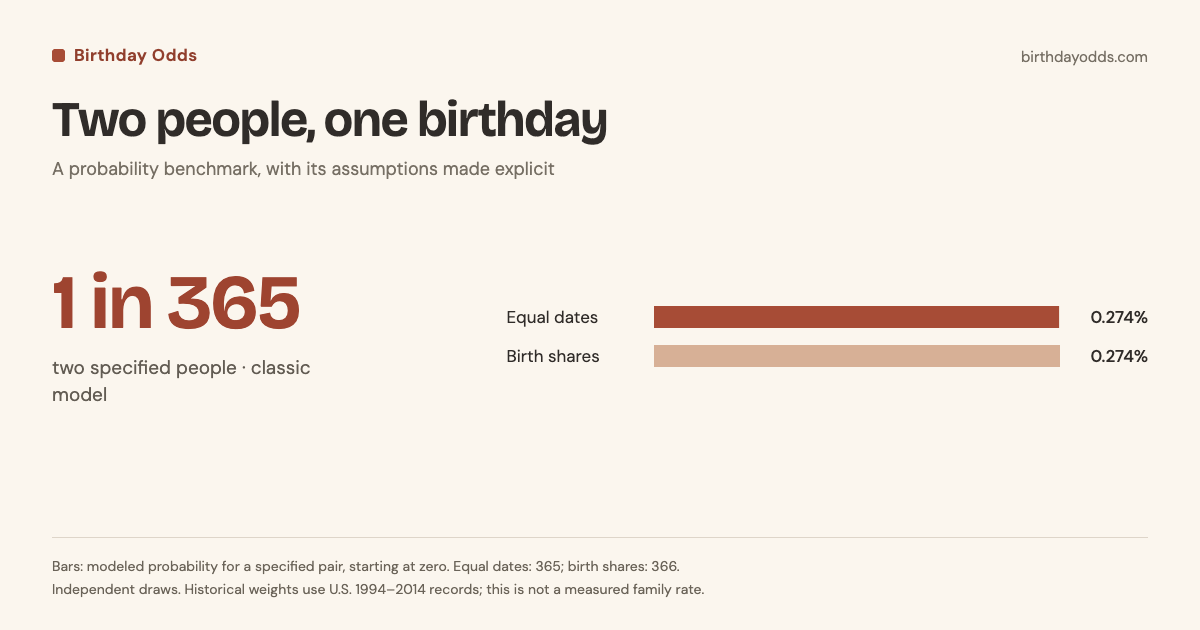
Two independently selected people have a 1 in 365 chance of sharing a birthday in the classic model: 0.2740%. That model gives each of 365 month/day dates an equal chance and excludes February 29.
Using the observed shares of U.S. recorded births from 1994 through 2014 instead gives 0.2744%, or about 1 in 364. Both are modeled probabilities. The odds for someone to match your already-known birthday depend on your particular date.
Two people, one birthday
A probability benchmark, with its assumptions made explicit
Bars: modeled probability for a specified pair, starting at zero. Equal dates: 365; birth shares: 366. Independent draws. Historical weights use U.S. 1994–2014 records; this is not a measured family rate.
Are you matching your birthday or choosing two people?
If your birthday is already known, the question is whether one other person has that date. In the classic equal-date model, the answer is 1 in 365 for every supported date.
Dates have different shares in the historical U.S. records. If your birthday's share is p, an independent draw from those records matches it with probability p. September 9 and February 29 therefore give different modeled chances.
| Known birthday | One other matches | Two others both match | At least one of 22 others matches |
|---|---|---|---|
| September 9 | 0.3024% | 0.000915% | 6.45% |
| July 4 | 0.2162% | 0.000467% | 4.65% |
| December 25 | 0.1617% | 0.000262% | 3.50% |
| February 29 | 0.0613% | 0.000038% | 1.34% |
Read "one other matches" for the single-person question. The other columns ask whether two people both match your date or at least one of 22 does. Knowing which event you mean is as important as the number.
You can look up your own birthday's share. The share describes these recorded births, rather than everyone you might meet.
Why does a random pair use a sum of squared shares?
When neither birthday is specified, both people might share any date. For a date with birth share p, the chance that both independently land on that specific date is p × p, or p². Add that quantity across all dates:
P(two random people share a birthday) = sum of p² over all birthday dates
In the classic model there are 365 equally likely dates. The sum is 365 × (1/365)² = 1/365. The first person can have any date; the second needs to match it. Multiplying 1/365 by 1/365 without adding across possible dates would answer a different question: both having one specified birthday.
The historical calculation uses all 366 observed birth shares, including February 29. A common date is more likely to be the first person's birthday and more likely to be matched by the second. The Berkeley probability notes explain the multiplication rule for independent events.
Why does the birthday paradox give much higher odds?
The 1-in-365 answer concerns one pair. A group gives many possible pairs, and any of them can match. The Harvard birthday-problem solution distinguishes a match anywhere in a group from matching one specified person.
Use the birthday paradox calculator for a group. For a specified person's date with share p, the chance of at least one match among m independent others is:
P(at least one matches your date) = 1 − (1 − p)^m
The table above uses m = 22. The three-person article explains what changes when all three people need to share one date. The sibling article treats family examples separately, because independent sampling is only a benchmark for real siblings.
What the historical model can and cannot tell you
Our weights come from 85,712,738 recorded U.S. births compiled by FiveThirtyEight: CDC/NCHS for 1994 through 1999, then SSA for 2000 through 2014, without overlapping years. The methodology explains the sources' different administrative coverage.
Each modeled person is drawn independently from the same historical distribution. The results do not measure real encounters, current populations, or birthdays worldwide. They match month and day only, without requiring the same birth year.
Download the probability calculations to inspect the date weights, assumptions, and group results.