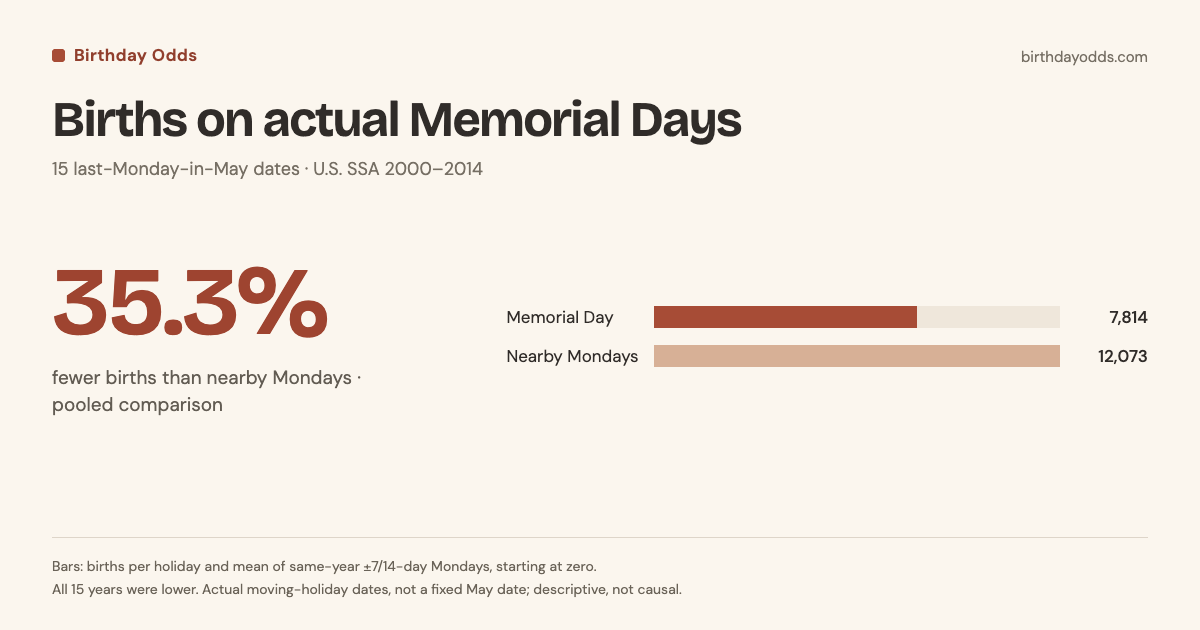
Yes, in U.S. SSA birth records from 2000 through 2014. Memorial Day averaged 7,813.9 recorded births, compared with 12,072.8 on nearby Mondays: 35.3% fewer by this comparison. The holiday count was lower in all 15 years.
The comparison follows the actual holiday each year. Memorial Day is the last Monday in May, so looking only at a May 26 birthday would miss most Memorial Days and include many ordinary dates.
Births on actual Memorial Days
15 last-Monday-in-May dates · U.S. SSA 2000–2014
Bars: births per holiday and mean of same-year ±7/14-day Mondays, starting at zero. All 15 years were lower. Actual moving-holiday dates, not a fixed May date; descriptive, not causal.
How does each Memorial Day compare with nearby Mondays?
For each holiday, we averaged the recorded births on the Mondays one and two weeks before and after it. These controls stay in the same year and compare Mondays with Mondays, rather than comparing a holiday Monday with an adjacent weekend day.
| Year | Memorial Day | Recorded births | Nearby Monday mean | Difference | Control dates |
|---|---|---|---|---|---|
| 2000 | 2000-05-29 | 8,272 | 11,666 | -29.1% | 2000-05-15; 2000-05-22; 2000-06-05; 2000-06-12 |
| 2001 | 2001-05-28 | 7,993 | 11,633.3 | -31.3% | 2001-05-14; 2001-05-21; 2001-06-04; 2001-06-11 |
| 2002 | 2002-05-27 | 7,765 | 11,622 | -33.2% | 2002-05-13; 2002-05-20; 2002-06-03; 2002-06-10 |
| 2003 | 2003-05-26 | 7,933 | 12,027.8 | -34.0% | 2003-05-12; 2003-05-19; 2003-06-02; 2003-06-09 |
| 2004 | 2004-05-31 | 7,869 | 12,221.5 | -35.6% | 2004-05-17; 2004-05-24; 2004-06-07; 2004-06-14 |
| 2005 | 2005-05-30 | 7,886 | 12,239.5 | -35.6% | 2005-05-16; 2005-05-23; 2005-06-06; 2005-06-13 |
| 2006 | 2006-05-29 | 8,099 | 12,726.8 | -36.4% | 2006-05-15; 2006-05-22; 2006-06-05; 2006-06-12 |
| 2007 | 2007-05-28 | 7,917 | 12,726.3 | -37.8% | 2007-05-14; 2007-05-21; 2007-06-04; 2007-06-11 |
| 2008 | 2008-05-26 | 7,948 | 12,566.8 | -36.8% | 2008-05-12; 2008-05-19; 2008-06-02; 2008-06-09 |
| 2009 | 2009-05-25 | 8,058 | 12,472.5 | -35.4% | 2009-05-11; 2009-05-18; 2009-06-01; 2009-06-08 |
| 2010 | 2010-05-31 | 7,436 | 11,924.8 | -37.6% | 2010-05-17; 2010-05-24; 2010-06-07; 2010-06-14 |
| 2011 | 2011-05-30 | 7,492 | 11,868.3 | -36.9% | 2011-05-16; 2011-05-23; 2011-06-06; 2011-06-13 |
| 2012 | 2012-05-28 | 7,532 | 11,848.3 | -36.4% | 2012-05-14; 2012-05-21; 2012-06-04; 2012-06-11 |
| 2013 | 2013-05-27 | 7,351 | 11,706.8 | -37.2% | 2013-05-13; 2013-05-20; 2013-06-03; 2013-06-10 |
| 2014 | 2014-05-26 | 7,657 | 11,841.8 | -35.3% | 2014-05-12; 2014-05-19; 2014-06-02; 2014-06-09 |
Across 15 actual Memorial Days, the records contain 117,208 births. We divide that total by the number of holidays to get the holiday average. The comparison average gives every year's set of four nearby Mondays equal weight.
The percentage compares the sum of holiday counts with the sum of those yearly control averages. It is not an average of the fifteen yearly percentages, and it does not count births prevented or moved to another day.
Is May 26 always Memorial Day?
No. The U.S. Office of Personnel Management defines Memorial Day as the last Monday in May. That can fall anywhere from May 25 through May 31. The table groups the holidays by their actual calendar date.
| Holiday date | Years | Occurrences | Births per occurrence | Nearby Monday mean | Difference |
|---|---|---|---|---|---|
| May 25 | 2009 | 1 | 8,058 | 12,472.5 | -35.4% |
| May 26 | 2003, 2008, 2014 | 3 | 7,846 | 12,145.4 | -35.4% |
| May 27 | 2002, 2013 | 2 | 7,558 | 11,664.4 | -35.2% |
| May 28 | 2001, 2007, 2012 | 3 | 7,814 | 12,069.3 | -35.3% |
| May 29 | 2000, 2006 | 2 | 8,185.5 | 12,196.4 | -32.9% |
| May 30 | 2005, 2011 | 2 | 7,689 | 12,053.9 | -36.2% |
| May 31 | 2004, 2010 | 2 | 7,652.5 | 12,073.1 | -36.6% |
Each date group is small. A different gap between two rows can reflect the years in each group and changes in birth counts, even though all holiday dates are Mondays. The groups do not establish that the May day number explains a difference in birth counts.
For a fixed-date birthday, use the May birthday guide. It ranks all May dates in the broader 1994 through 2014 baseline and separately examines May 26. This study uses only SSA 2000 through 2014 so that the holiday comparison stays within one source series.
Does the result depend on which Mondays we use?
Using only the Mondays one week before and after gives 35.5% fewer recorded births on Memorial Day. Using only the Mondays two weeks before and after gives 35.0% fewer. Both alternatives include every Memorial Day in the study.
We screened the nearby dates for other holidays and their standard observed dates, plus Christmas Eve, December 26 and the Friday after Thanksgiving. None of the 60 main comparison dates needed exclusion. The holiday screen leaves this Memorial Day comparison unchanged.
Nearby Mondays account for weekday and some local seasonal context. They cannot remove every difference in birth timing, hospital practice or population across the comparison dates. The gap stays similar with either window. That still does not show what caused it.
Why are there fewer recorded births on the holiday?
These daily files give birth counts, not delivery methods, hospital staffing or families' decisions. They show a lower Memorial Day count but cannot identify the reason for it or tell us what happened to individual births.
The weekday and weekend study supplies the ordinary weekly context. Our fixed-date holiday comparison and Thanksgiving study examine other holidays with their own controls. Their results should not be substituted for the Memorial Day calculation.
Sources and method
We used daily U.S. SSA birth records compiled by FiveThirtyEight: 62,187,024 recorded births across 5,479 actual dates, from January 1, 2000 through December 31, 2014. Every target and comparison date falls within that complete coverage.
The downloadable Memorial Day analysis contains each holiday, its birth count, all control dates, year-level differences, calendar-date groups and alternate windows. The methodology explains source coverage. These historical U.S. results do not describe worldwide Memorial Day births or predict the count on a future holiday. You can check a birthday against the site's historical month/day ranking.