Three specified people have a 1 in 133,225 chance of all sharing a birthday in the classic model: 0.000751%. It assumes independent birthdays on 365 equally likely month/day dates, excluding February 29.
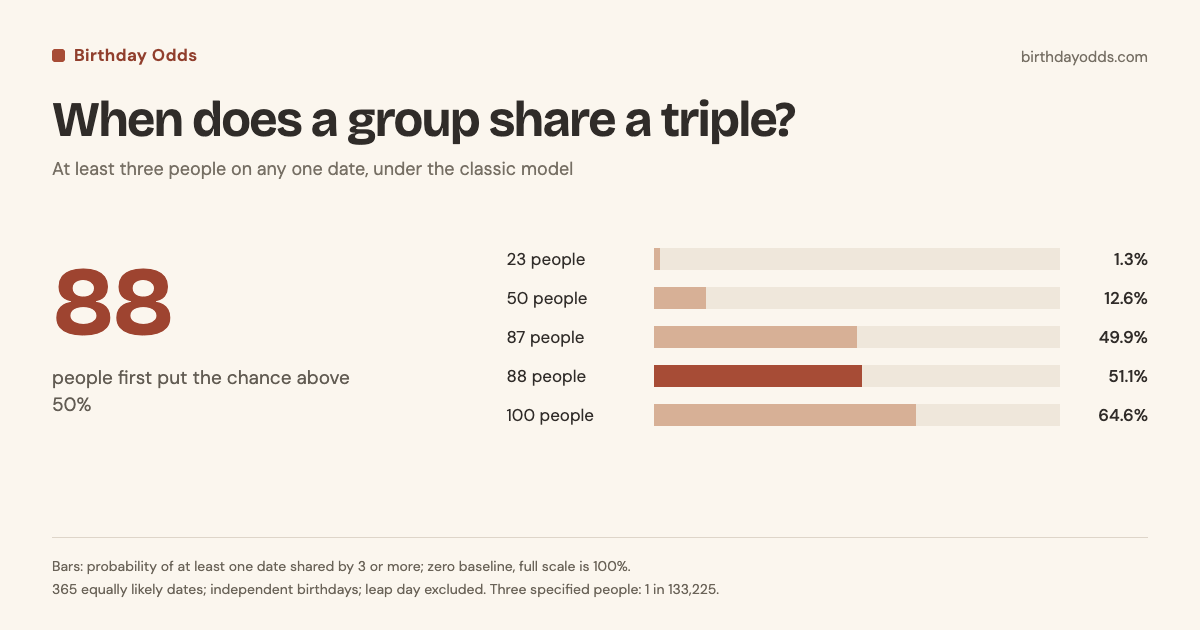
Finding any matching triple in a larger group is much more likely. With 23 people, the classic chance that at least three share one date is 1.27%; with 50 people, it is 12.64%. That question allows any three people in the group to match.
When does a group share a triple?
At least three people on any one date, under the classic model
Bars: probability of at least one date shared by 3 or more; zero baseline, full scale is 100%. 365 equally likely dates; independent birthdays; leap day excluded. Three specified people: 1 in 133,225.
Why is the answer 1 in 365 squared?
For three specified people, the first person's birthday can be any date. The second must match it, with chance 1/365, and the third must also match it, independently, with chance 1/365.
P(all three share any date) = (1/365) × (1/365) = 1/365²
Using three factors of 1/365 would instead mean all three have one particular date chosen in advance. That is a narrower event. The Harvard birthday-problem solution makes the same distinction when extending birthday matches to larger groups.
If the first birthday is already known and dates are not equally likely, use that date's share p. The chance that two independent others both match it is p². The two-person article explains how a known date differs from a random first person's date.
What changes with historical birth frequencies?
For three independently drawn people with no specified birthday, the chance all three have a date with share p is p³. Add p³ across every date to allow them to share any birthday.
The observed 366-date U.S. distribution from 1994 through 2014 gives 0.000755%, or about 1 in 132,450, for a specified triple. This is a model using recorded birth shares, not a measured rate among current groups of people.
| Known birthday | One other matches | Two others both match | At least one of 22 others matches |
|---|---|---|---|
| September 9 | 0.3024% | 0.000915% | 6.45% |
| July 4 | 0.2162% | 0.000467% | 4.65% |
| December 25 | 0.1617% | 0.000262% | 3.50% |
| February 29 | 0.0613% | 0.000038% | 1.34% |
In this table, read "two others both match" for a birthday you already know. That column uses p². When all three birthdays are unknown, the sum of p³ allows them to share any date.
How likely is a triple anywhere in a group?
The group event is that at least one date belongs to three or more people. A group with four people sharing a date also qualifies. Two separate matching pairs do not qualify unless three people share the same date.
| People | Classic any triple | Historical any triple |
|---|---|---|
| 3 | 0.000751% | 0.000755% |
| 10 | 0.089% | 0.089% |
| 23 | 1.271% | 1.278% |
| 30 | 2.853% | 2.869% |
| 50 | 12.638% | 12.700% |
| 87 | 49.945% | 50.116% |
| 88 | 51.107% | 51.278% |
| 100 | 64.586% | 64.763% |
The classic model first exceeds 50% at 88 people. The historical 366-date model crosses at 87. At 87 people, the values are 49.945% and 50.116%, respectively, so a small numerical difference changes the first whole-number threshold.
This comparison changes both the date weights and whether February 29 is possible. It does not isolate a seasonal effect or show the threshold for real classrooms or families.
How did we calculate the group probabilities?
We calculate the chance that no date has more than two people, then subtract it from 1. A date can hold nobody, one person, or two people. Summing all those allowed arrangements gives the probability of no matching triple.
For equal dates, a separate count groups arrangements by how many dates hold a pair. For the historical model, we combine each date's probability weights while allowing at most two people per date. The downloadable calculations describe the recurrence and give the unrounded results.
Simply multiplying the number of possible triples by a single triple's chance gives the expected number of matching triples, not the probability of at least one. Triples can overlap, just as pairs do in the birthday paradox.
Sources and limits
The historical weights use U.S. birth records compiled by FiveThirtyEight: CDC/NCHS 1994 through 1999 followed by SSA 2000 through 2014, without overlapping years. Administrative coverage differs between sources. Both models use independent draws; the Berkeley probability notes explain that assumption.
Birth years do not need to match. These calculations do not describe everyone alive, birthdays worldwide, or dependent birth dates within a family. For that last question, see the sibling benchmark. The methodology covers the source scope, and the birthday checker gives each date's historical share.